
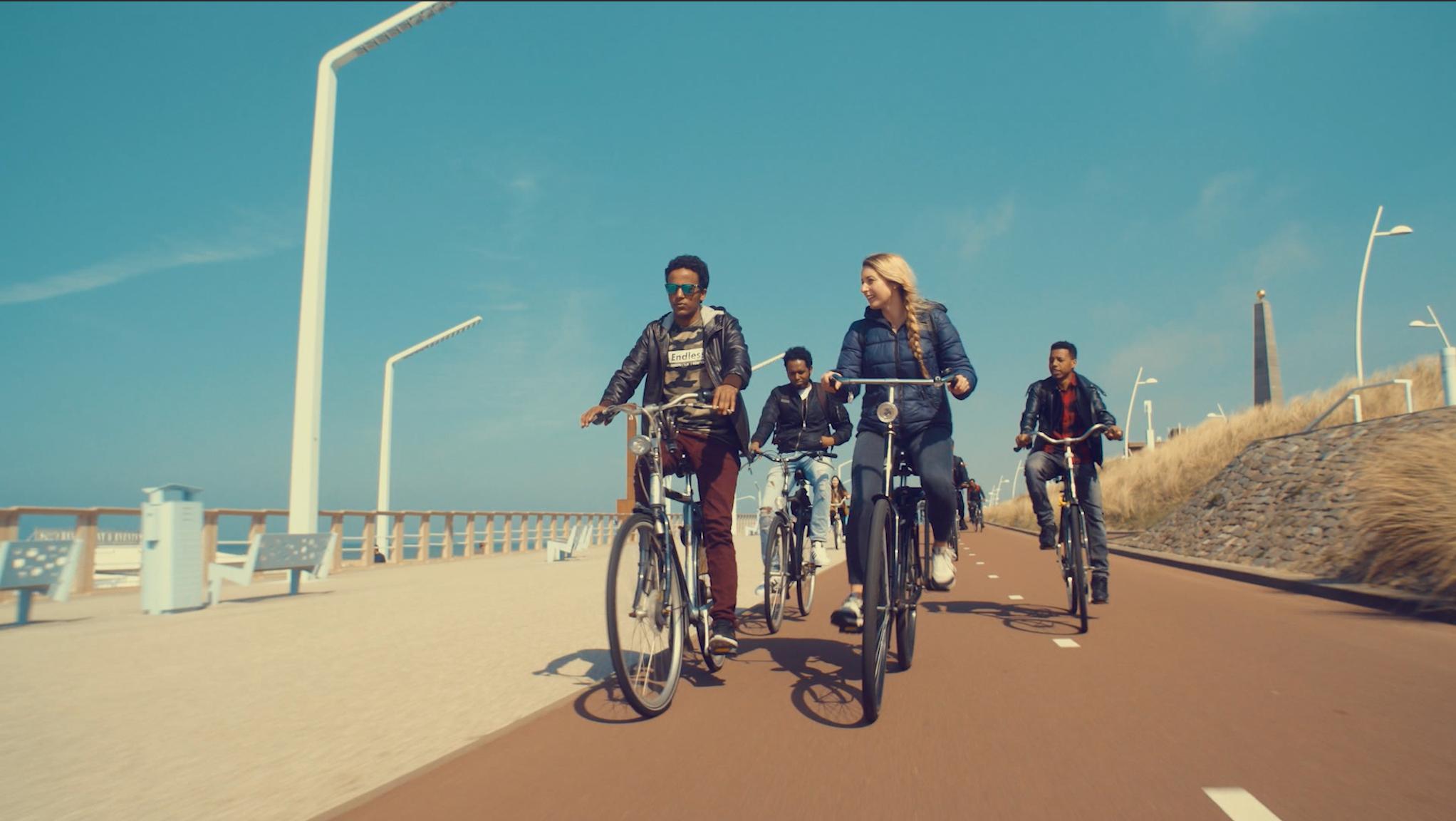
At the first film screening of our current series on well-being, a survey was conducted on the reception of Gertjan Hulster’s & Arne Gielen’s WHY WE CYCLE. Here we present some preliminary results from the questionnaire responses.
I. THE FILM
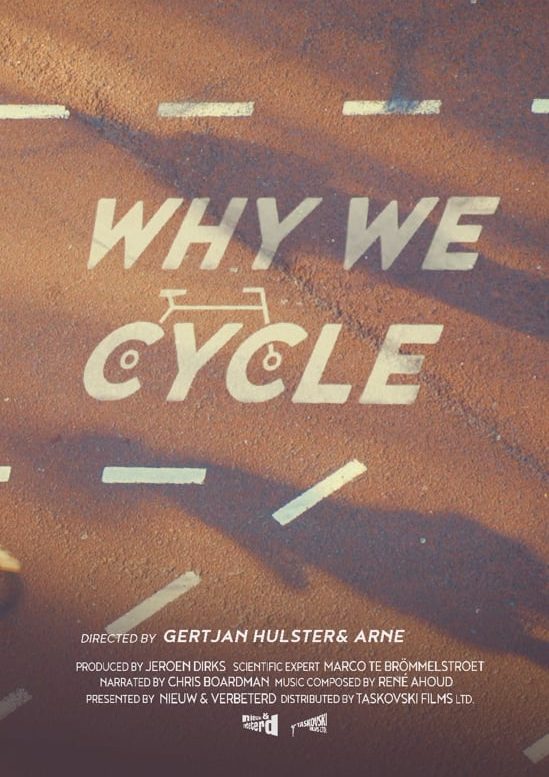
Gertjan Hulster & Arne Gielen | 2020 | Netherlands | 56 min | OV with Subtitles
For the Dutch, cycling is as normal as breathing. They don’t think about it, they just do it – in all seasons and in all weathers, in the countryside and in the city.
Perhaps the fact that they don’t think about it is also the key to the bicycle’s great success in the Netherlands.
The documentary film Why We Cycle takes a bike ride with ordinary cyclists and experts from various disciplines. These conversations reveal some obvious, but even more hidden, effects of cycling on people, society, and the organization of cities. A film that makes you want to get on your bike.
II. DATA COLLECTION
Why We Cycle was screened on October 28, 2025, at the Harmonie Kino in Freiburg. Approximately 100 attendees had the option to fill out either a paper or an online questionnaire. In addition to attitudes toward alternative, ecologically sustainable economic systems, the survey also explored emotional reactions to the film.
The questionnaire had three parts: the first was completed just before the screening, the second immediately after the film, and the third following the panel discussion with experts Fabian Kern, VCD Freiburg, Zeinab El Hage Ali, Bike Bridge Freiburg and Gregor Falter, Bike Bridge Freiburg.
III. INITIAL RESEARCH RESULTS
What follows is an overview of the initial descriptive analysis of the responses. The letter “n” indicates the number of people who answered a given question. For example, “n=67” means that 67 audience members responded. All results should be considered preliminary, pending further in-depth analysis.
The survey showed that it is very important to viewers (91.5%) to live in a bicycle-friendly environment, as illustrated in Figure 1.
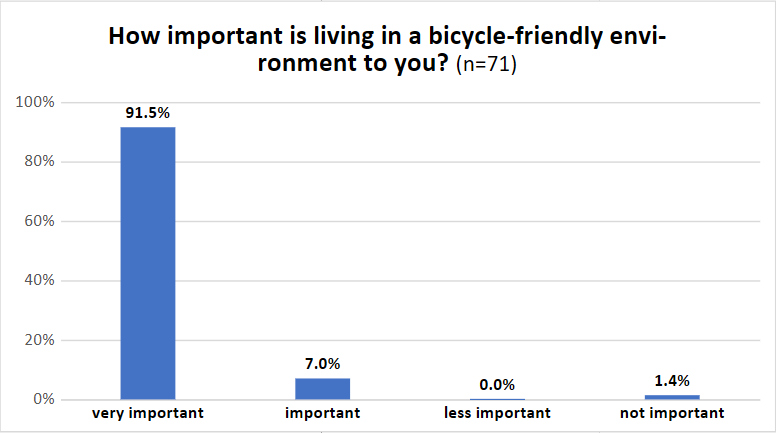
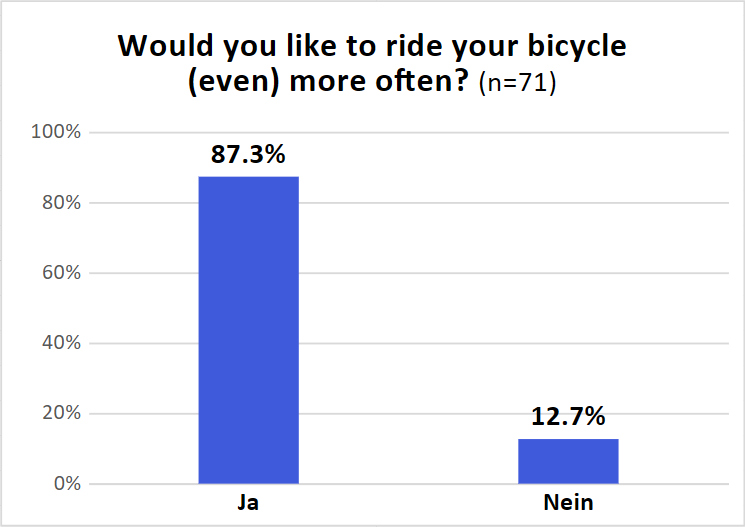
Figure 2 further shows, that 87.3% of our respondents would like to ride their bike (even) more often.
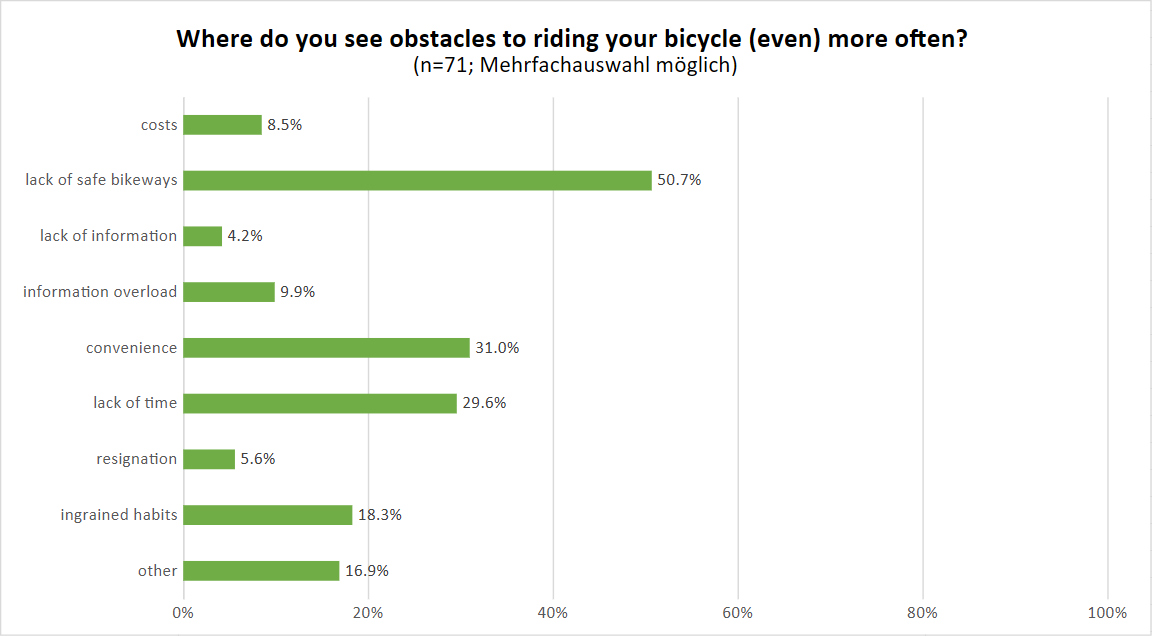
There are also obstacles to this, however. As Figure 3 shows, it is primarily the lack of safe cycle paths (50.7%) that is perceived as an obstacle to cycling (even) more. In addition, a certain degree of convenience (31.0%) and lack of time (29.6%) also play a role, albeit to a lesser extent.
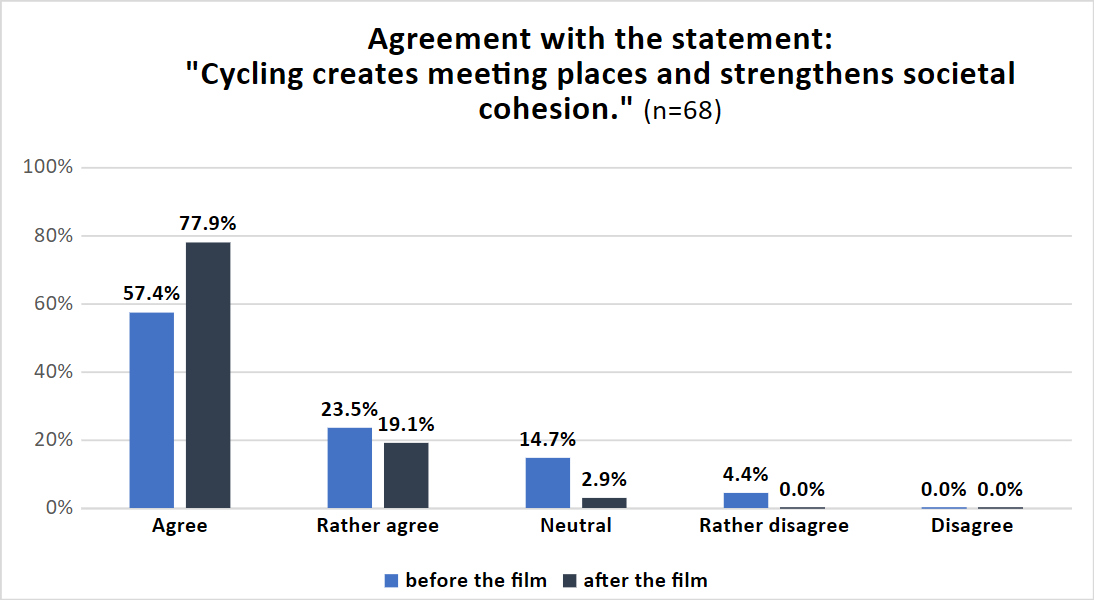
We were particularly interested in the social aspect of cycling. The film enabled us to measure a change in attitudes. As can be seen in Figure 4, after the film was shown, agreement with the statement ‘Cycling creates opportunities for people to meet and promotes social solidarity’ increased significantly, from 57.4% to 77.9% (‘agree’).
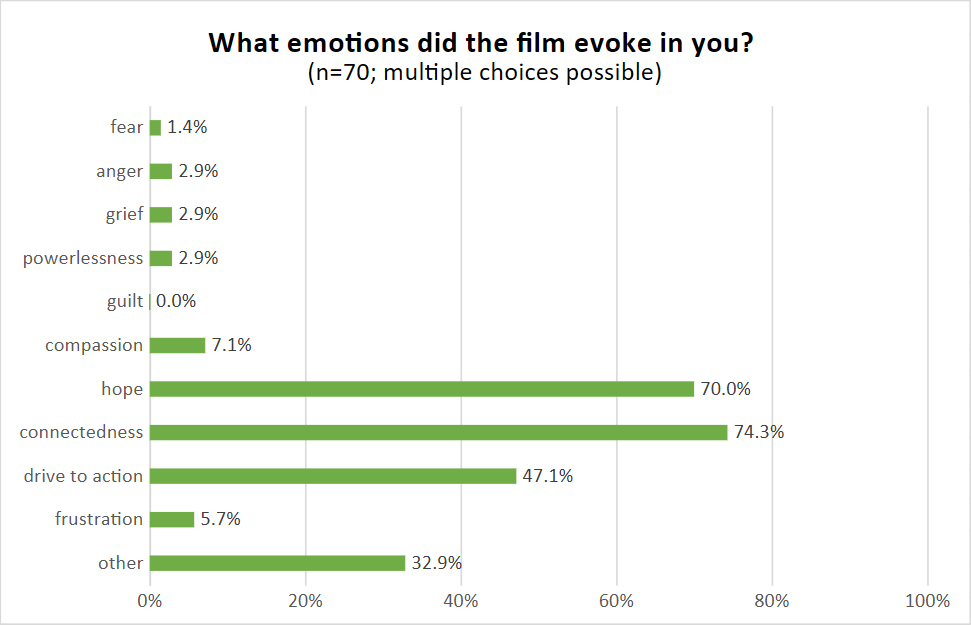
In this survey, we again asked about emotional reactions to the film. As Figure 5 shows, the majority of respondents stated that the documentary evoked feelings of connectedness (74.3%) and hope (70.0%). The third most frequently cited emotion was a drive to action (47.1%).
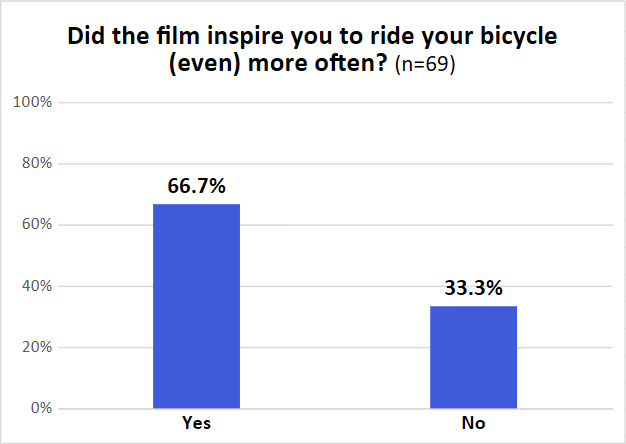
Whether WHY WE CYCLE led our viewers to want to cycle (even) more was answered in the affirmative by a majority of 66.7%, as can be seen in Figure 6. A look at the optional reasons given for the answers shows that many of the respondents already cycle very frequently, making it hard to increase the frequency they cycle much further.
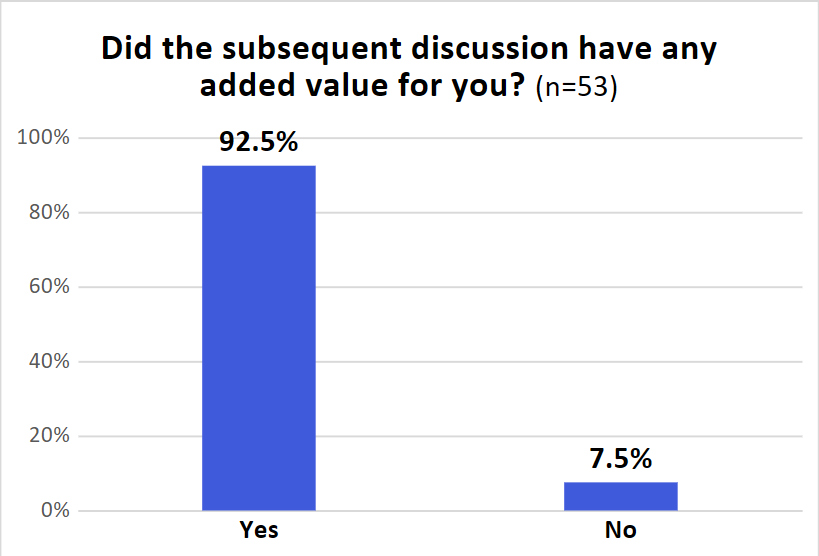
The responses from our viewers to the question of whether the subsequent discussion provided additional value were also important in relation to our research questions. 92.5% of respondents said that this was the case (see Figure 7). This high figure supports our assumption that it can be useful to offer documentary films on topics of sustainability in combination with a subsequent discussion with experts.
IV. CONCLUSION
In summary, our evaluation shows that Outgrow the System primarily evoked a feelings of connectedness and hope among our audience. The Film also had a positive influence on attitudes towards the social dimensions of cycling in terms of creating opportunities for people to meet and promoting social solidarity. The subsequent discussion with experts from the field of research provided significant added value for the audience.
The expert panel discussion added value for a majority of the attendees.
We would like to thank everyone who participated in the survey!
The next step will be a deeper analysis of the collected data, along with correlation analysis. Stay tuned!
VISIONS OF SUSTAINABILITY is an inter- and transdisciplinary research project funded by the Innovation Sustainability Campus (ICN), located at the Albert Ludwig University of Freiburg and the Karlsruhe Institute of Technology (KIT). Non-university cooperation partners include Harmonie Kino, the Volkshochschule Freiburg and Greenmotions. The Freiburg environmental mayor Christine Buchheit has take on the patronage of the project.