
At the fourth and final film event as part of the VISIONS OF SUSTAINABILITY climate protection series, a survey was carried out on the reception of Nic Balthazar’s DUTY OF CARE – THE CLIMATE TRIALS. Here we present the first results from the questionnaires.

DUTY OF CARE – THE CLIMATE TRIALS
Nic Balthazar| 2023 | Netherlands | 56 mins | OmU
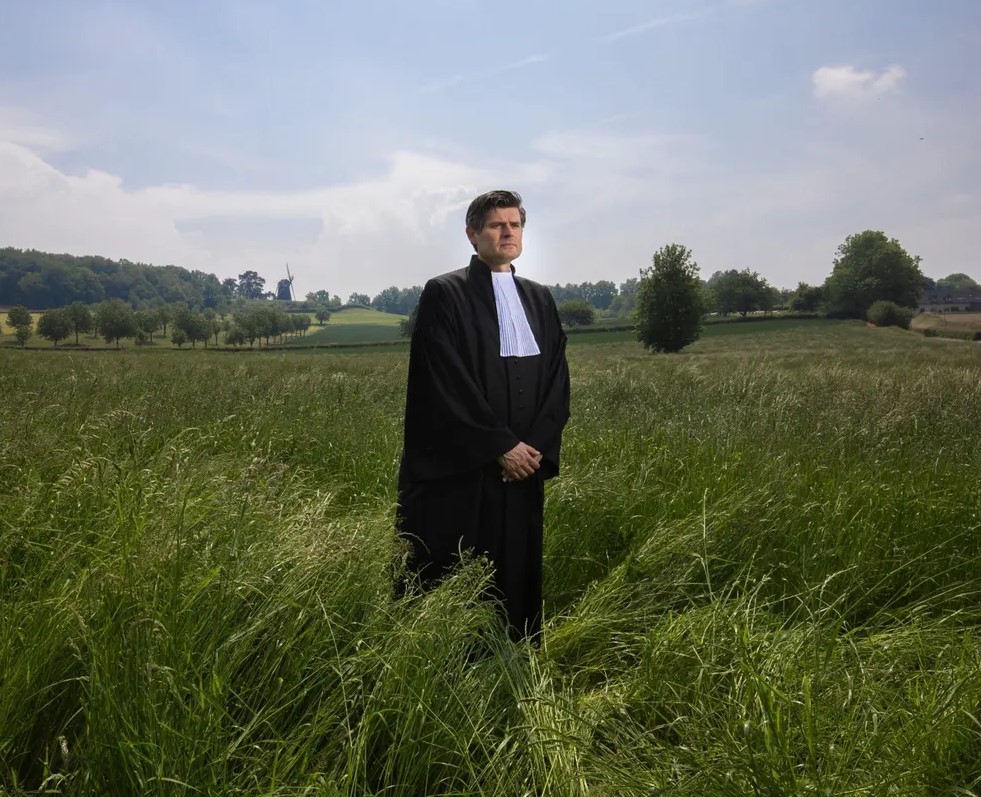
DUTY OF CARE accompanies the lawyer Roger Cox, who is suing powerful states and corporations for climate protection. Cox is a family man, lawyer and nature lover. Until 2006, he considered climate change to be an acceptable evil. But then a documentary film – Davis Guggenheim’s An Inconvenient Truth – shocks Cox so much that he decides to fight the impending catastrophe through legal means. He finds allies, sues the Dutch government and the oil and gas company Shell – and wins in court.
I. DATA COLLECTION
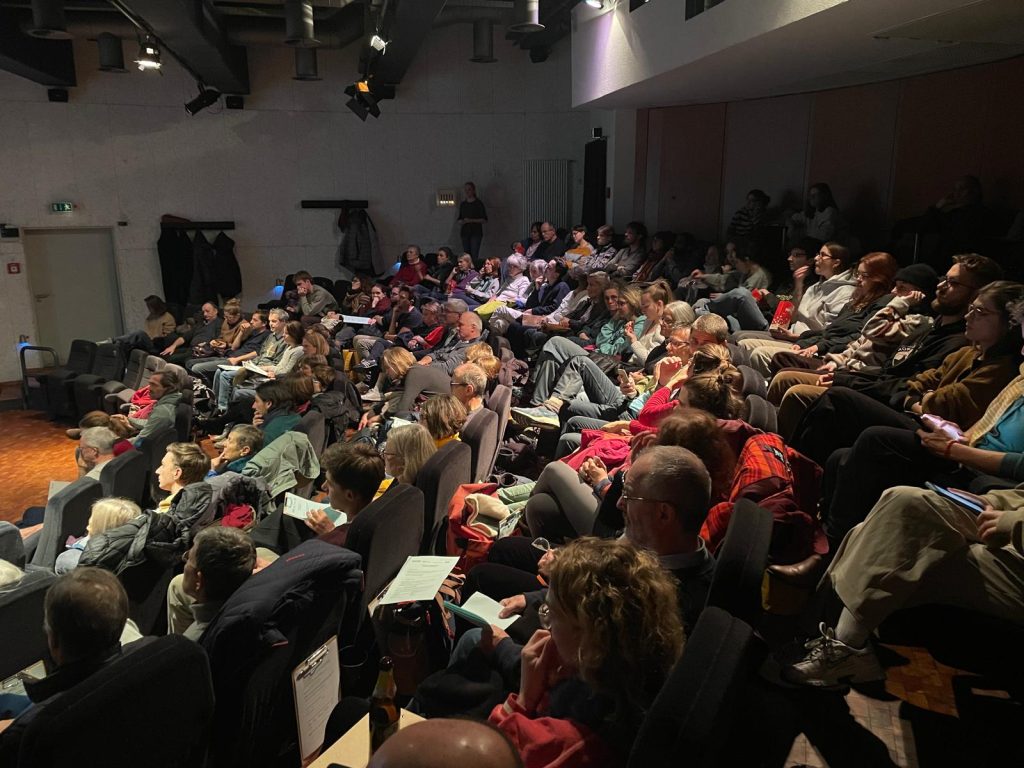
DUTY OF CARE was shown on January 14th, 2025 at the Harmonie Kino Freiburg. The approximately 100 spectators had the choice between an online and a paper questionnaire. In addition to attitudes towards the role of legal means in climate protection, emotional reactions to the film were also asked.
The questionnaire consisted of three parts: the first part was completed shortly before the film screening and the second part immediately after the film. The third part followed the subsequent panel discussion with Hannah Münstermann from the Climate Clinic, who, together with other aspiring lawyers, researches climate law topics on a voluntary basis and prepares them for non-lawyers.
III. THE FIRST RESEARCH RESULTS
Here is an insight into the first, descriptive evaluation of the questionnaire: The so-called “n” stands for the number of people who answered the question. An “n=55” means that 55 viewers submitted an answer.
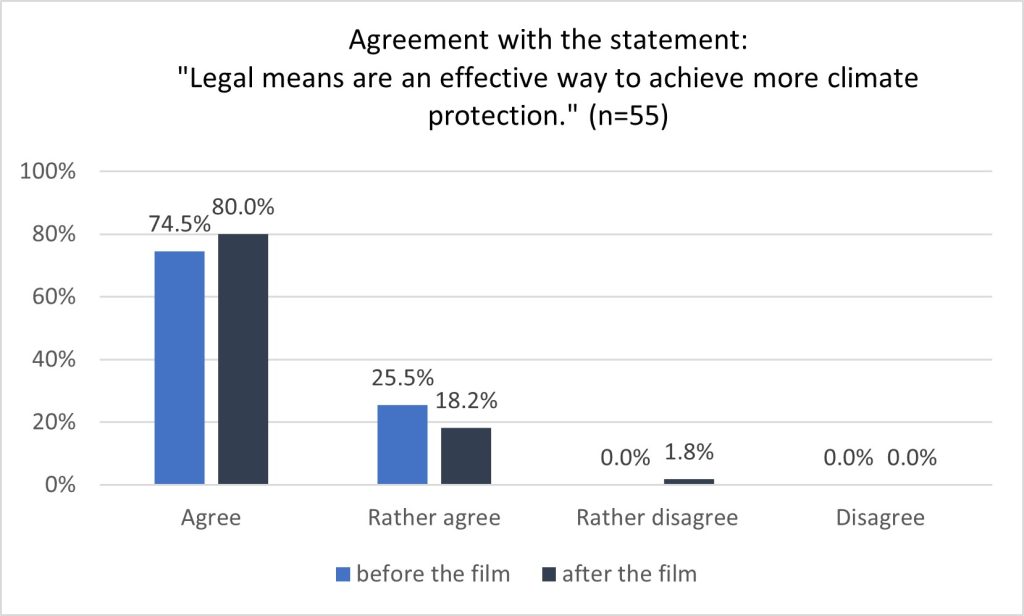
Of particular interest for us in this film were the attitudes towards legal means in the fight for more climate protection. As can be seen in Figure 1, after the film screening, agreement with the statement “Legal means are an effective way to achieve more climate protection” increased slightly from 74.5% to 80.0% (“Agree”).
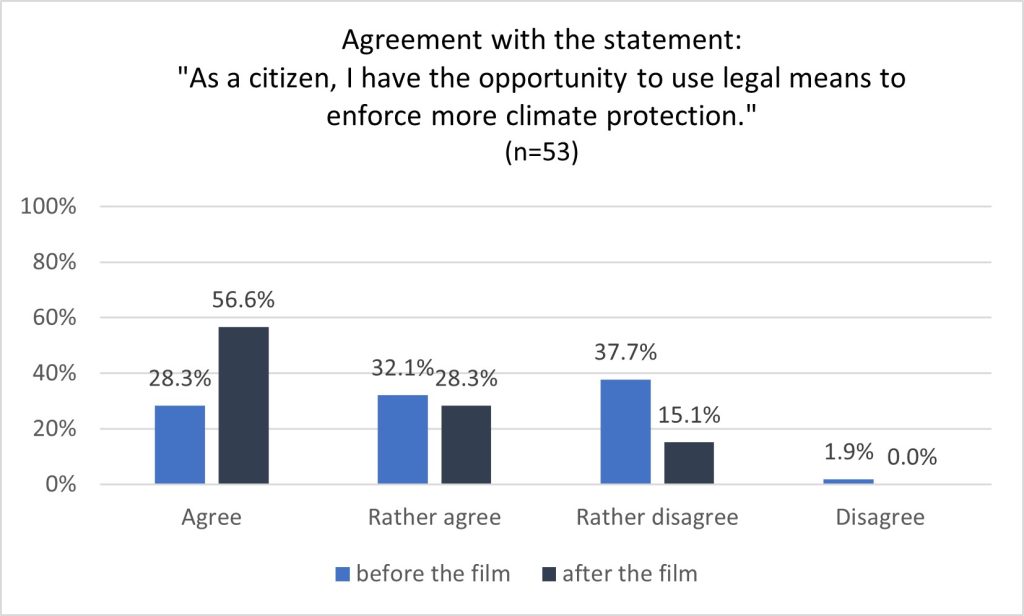
What is particularly interesting, however, is the agreement with the statement: “As a citizen, I have the opportunity to use legal means to enforce more climate protection” (Figure 2). While a total of 28.3% of viewers answered this statement with “agree” before the film, the figure increased significantly after the film screening to 56.6%. It can be concluded from this that many of our viewers felt that they had significantly greater opportunities to take legal action after watching the film. Since many citizens appear as co-plaintiffs in the court proceedings shown in DUTY OF CARE, and their impact is emphasized several times, further data analysis will have to clarify whether these moments were perceived as particularly moving by the viewers.
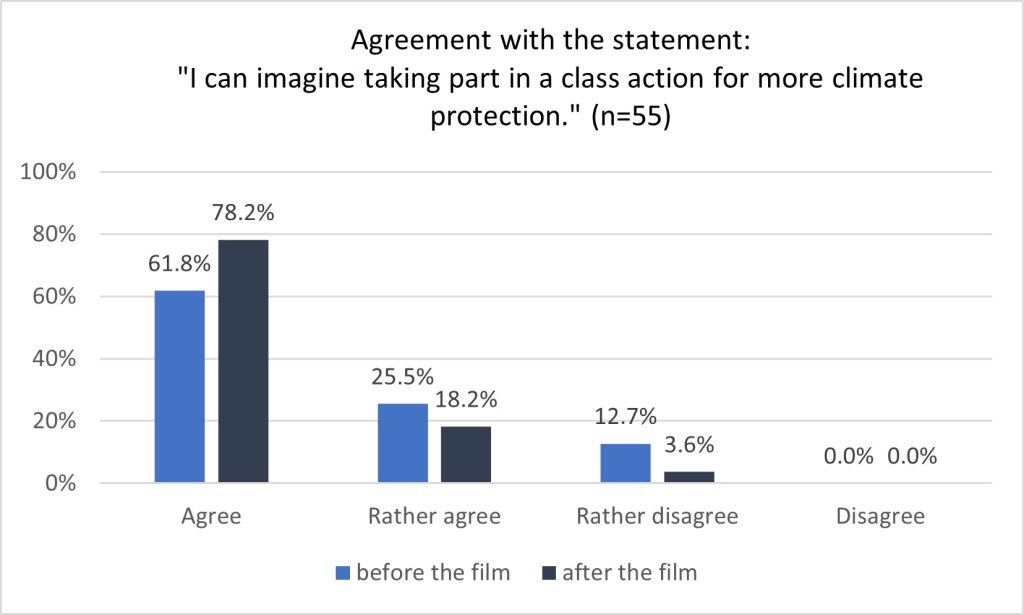
Also revealing in this context is the agreement with the statement “I can imagine taking part in a class action lawsuit for more climate protection”. As Figure 3 shows, a shift towards agreement with this statement was observed among our viewers. While 61.8% answered “Agree” before the film screening, 78.2% of viewers answered after the film.
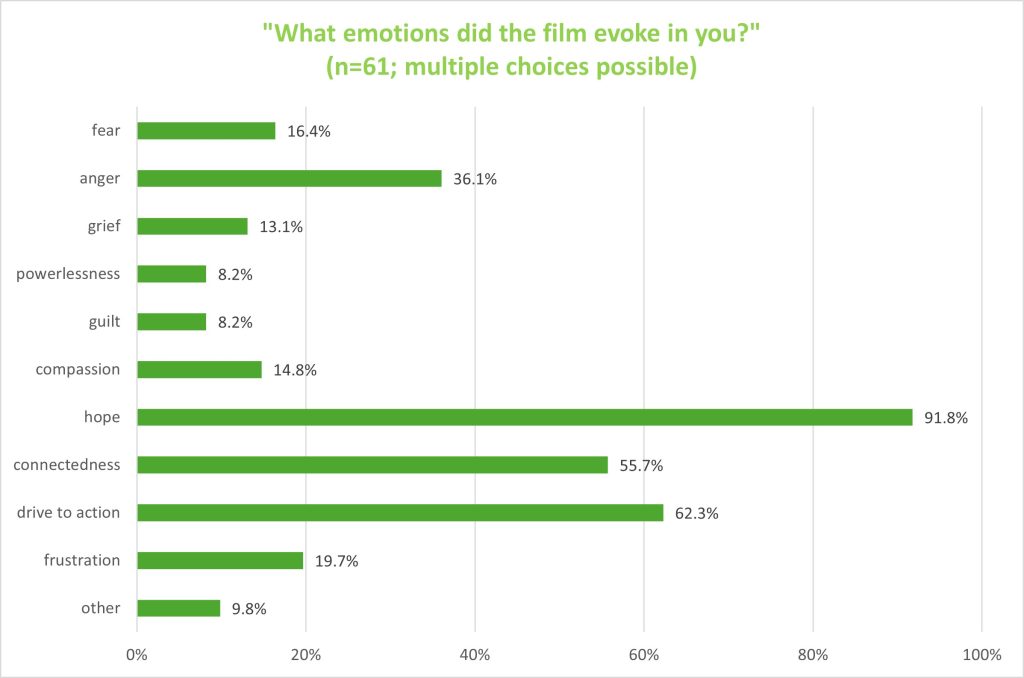
In this survey we again asked about emotional reactions to the film. As Figure 4 shows, the vast majority (91.8%) of respondents said the documentary gave them “hope.” The second most frequently cited feeling was a “drive to action” (62.3%), followed by a feeling of “connectedness” (55.7%). 36.1% of viewers felt anger; other emotions, such as fear, guilt, powerlessness, frustration and sadness, but also compassion, were mentioned significantly less frequently.
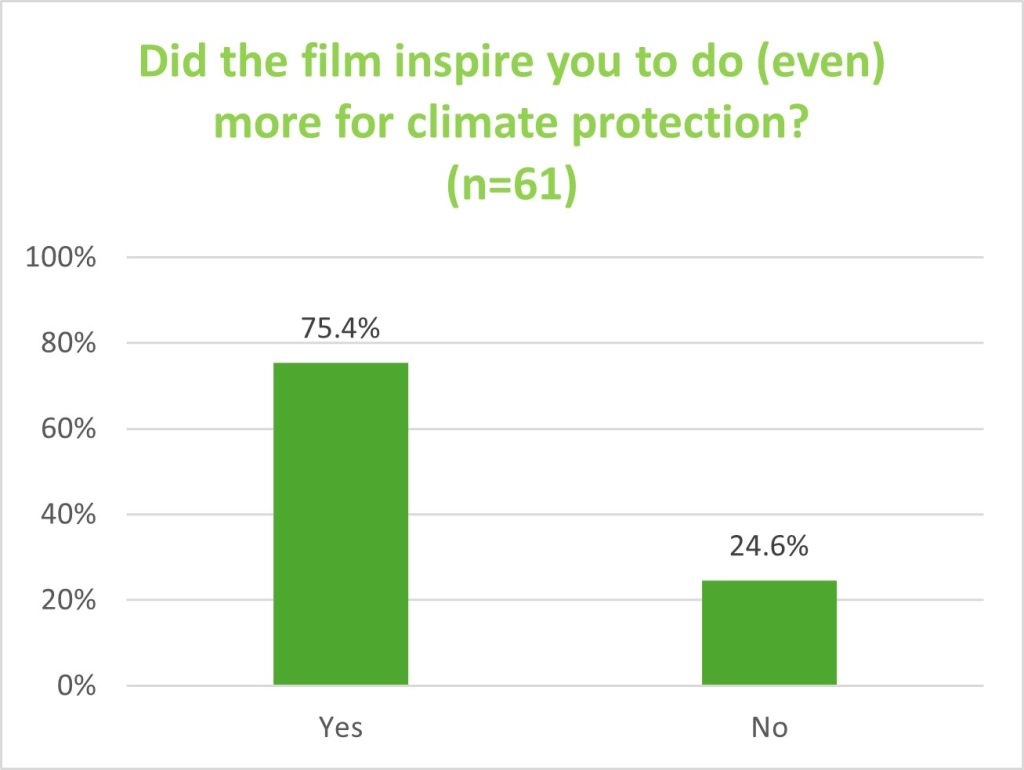
Whether DUTY OF CARE encouraged people to do (even) more for climate protection was answered in the affirmative by the majority of our viewers (75.4%), thus showing a clear result, as can be seen in Figure 5.
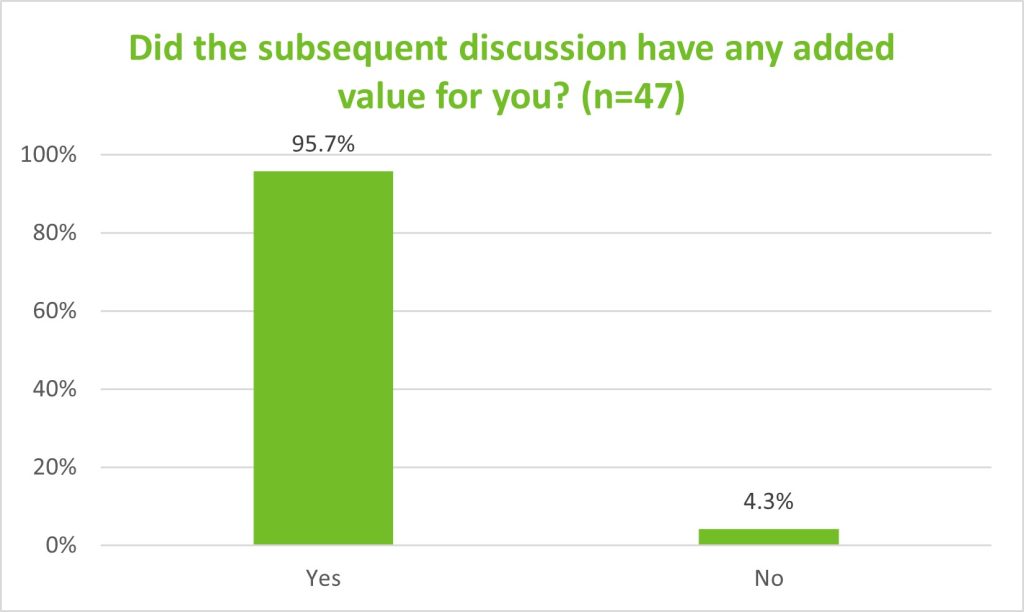
Particularly important in connection with our research questions were the answers from our viewers to the question of whether the subsequent discussion with Hannah Münstermann from the Climate Clinic had added value. Figure 6 shows that nearly 96% of viewers said this was the case. This high value supports our assumption that it can make sense to offer documentaries on sustainability issues in combination with a subsequent discussion with experts – especially when it comes to a complex legal issue such as climate lawsuits.
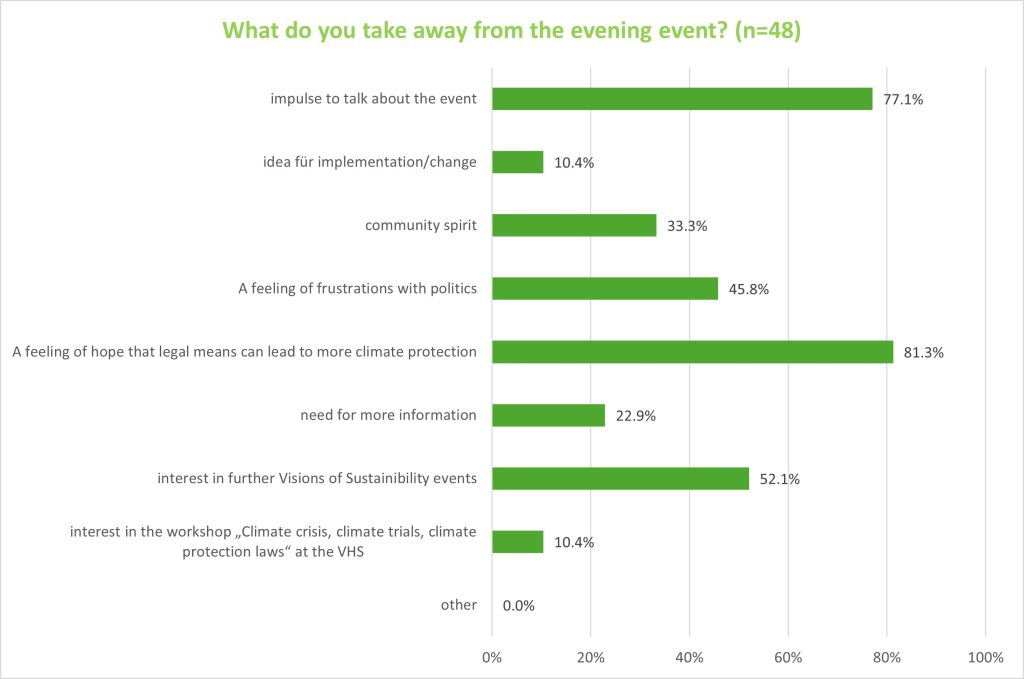
As in every film event, we wanted to know what viewers would take away with them at the end of the evening after the panel discussion. Figure 7 shows that a very large proportion of the audience, over 80%, took away from the event “a feeling of hope that legal means can lead to more climate protection” and 77.1% an “impulse to talk to others”. 52.1% expressed interest in further VISIONS OF SUSTAINABILITY events. 45.8% of the participants took away from the event “a feeling of frustration that so little is happening at the political level” and 33.3% a “feeling of community”. Given the perceived added value of the discussion, it is noteworthy that both the need for more information (22.9%) and the interest in the in-depth workshop offered by Hannah Münstermann (10.4%) were comparatively low, as was the number of viewers who stated that they had taken away an “idea for implementation/change” (10.4%).
IV. CONCLUSION
In summary, the first evaluation of the data shows that Nic Balthazar’s DUTY OF CARE triggered a feeling of hope in many of our viewers combined with a drive to action. The film also had an impact on attitudes towards the effectiveness of legal means in the fight for more climate protection and on citizens’ perceptions of their personal freedom of action. Many spectators took away from the event the hope that legal means could lead to more climate protection, but this was accompanied by a comparatively low interest in further information.
We thank everyone who took part in our survey!
The next step involves an in-depth evaluation of the data collected and the addition of a context analysis. Stay tuned!
VISIONS OF SUSTAINABILITY is an inter- and transdisciplinary research project funded by the Innovation Sustainability Campus (ICN), located at the Albert Ludwig University of Freiburg and the Karlsruhe Institute of Technology (KIT). Non-university cooperation partners include Harmonie Kino, the Volkshochschule Freiburg and Greenmotions. The Freiburg environmental mayor Christine Buchheit has take on the patronage of the project.