

On July 3rd, in cooperation with VHS Freiburg, we held our final summer workshop on “Community-Supported Business Models.” Nick von Andrian and Merle Hildebrandt from the Humboldt Professorship for Sustainable Food Systems at the University of Freiburg presented the Lernwerkstatt KoWerk.
Building on the film Outgrow the System, participants learned about various types of enterprises and cooperatives that operate in socially just and sustainable ways. Under the theme of cooperative economics in the food sector, the Lernwerkstatt KoWerkbrought together citizens from seven local businesses and initiatives in 2024. Over the course of the 10-week project, numerous aspects of community-based business management were explored and reflected upon. By structuring the learning workshop in this way, insights from academic research could be practically applied at the local level.
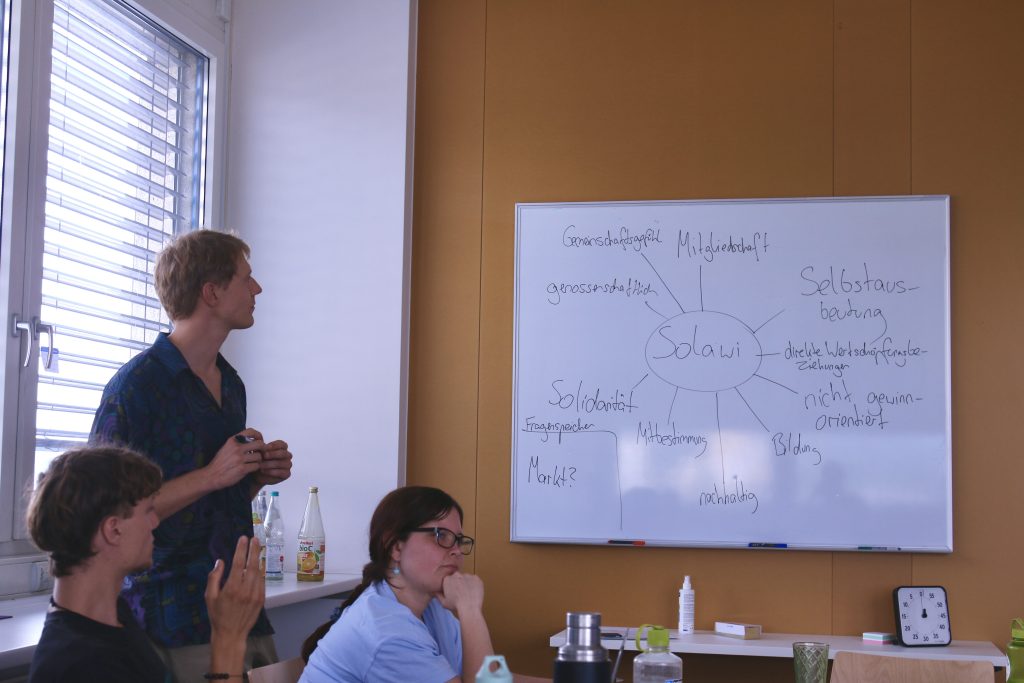
In the workshop, the example of Community Supported Agriculture (Solidarische Landwirtschaft, SoLaWi) was used to illustrate various aspects of community-backed, non-profit-oriented enterprises. Participants then examined funding models that are not tied to fluctuating market prices and demand. Through subscriptions or member contributions, businesses can be funded reliably, while customers in return receive benefits such as discounts or regular deliveries. Additionally, in some cooperative businesses, supporters even have the opportunity to participate in decision-making. Local examples mentioned included the Quartiersladen in Vauban, the St. Ferment Kombucha Brewery, and the Backhaus der Vielfalt in Sankt Georgen. To conclude the engaging workshop, participants had the chance to discuss questions that arose during the session around community-supported business models.
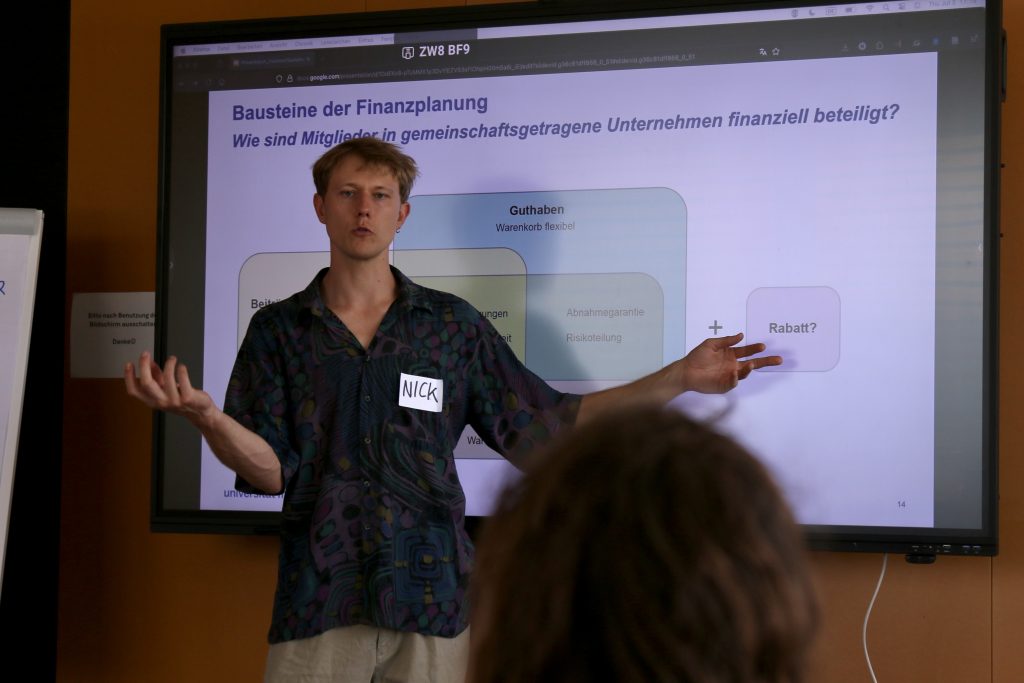
A second round of the KoWerk learning workshop is planned for next spring. For those interested, a variety of resources are available as templates for restructuring businesses and initiatives. These include the CSX Transformation Guide from the Next Economy Lab (NELA), sample financial plans from WirGarten, and templates, apps, and work tools from the Netzwerk Solidarische Landwirtschaft. On a personal level, political and civic engagement, as well as support for new economic models, can already contribute to making the economy more sustainable and fostering a more socially just society.
This workshop was part of VISIONS OF SUSTAINABILITY, an inter- and transdisciplinary research project funded by the Innovation Sustainability Campus (ICN), located at the Albert Ludwig University of Freiburg and the Karlsruhe Institute of Technology (KIT). Non-university cooperation partners include Harmonie Kino, the Volkshochschule Freiburg and Greenmotions. The Freiburg environmental mayor Christine Buchheit has taken on the patronage of the project.