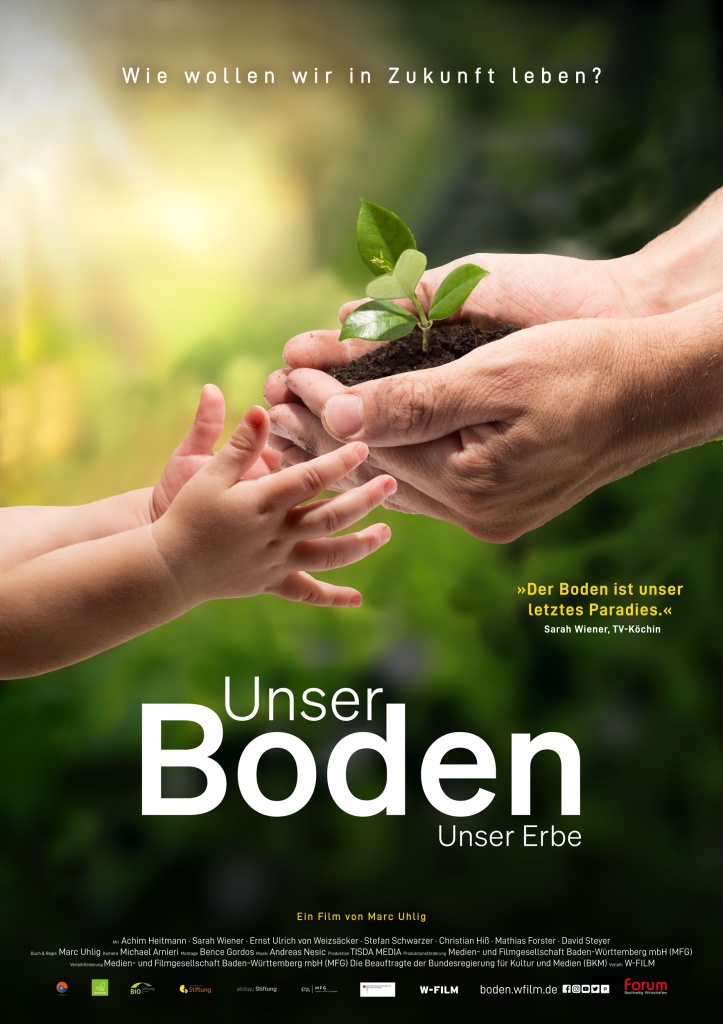
How must agriculture and society change so that we can pass on a vibrant world with living soils to our children? The opening film in our new series on RESOURCES, Unser Boden – Unser Erbe, shows how important and yet threatened our livelihood is.
Healthy soils are, after the oceans, the largest storage of greenhouse gases and contribute significantly to reducing CO2 emissions. But it takes our planet more than 2,000 years to form ten centimeters of fertile soil. And yet we use our soils as if they were inexhaustible. This puts our food source at great risk! What does this mean for the future? Director Marc Uhlig vividly conveys why this precious resource deserves our greatest appreciation. Because we can all contribute to maintaining soil fertility – whether as farmers, gardeners, or consumers in the supermarket! Experts such as TV chef Sarah Wiener and environmental scientist Ernst Ulrich von Weizsäcker provide valuable food for thought. An inspiring plea for future-oriented agriculture and sustainable nutrition.
SCREENING AND DISCUSSION (German original version; discussion in German)
Tuesday, April 29, 2025 at 8 pm
Harmonie Kino Freiburg
DISCUSSION PARTNERS
Florian Binder, organic farmer, Lindenbrunnenhof
Prof. Dr. Alexa Weik von Mossner, film scholar University of Freiburg
Entrance is free of charge, Registrtation via the VHS is required.
As a companion event to the film, we are offering a tour (in German) of the Lindenbrunnenhof farm in Forchheim on May 13, 2025, starting at 4:30 p.m. as part of a collaboration between VISIONS OF SUSTAINABILITY, the Volkshochschule Freiburg, and the Ernährungsrat. Following the screening of Unser Boden – Unser Erbe, the tour will provide an opportunity to learn about and discuss the concepts addressed in the film firsthand. The Lindenbrunnenhof farm, run by Christa and Otmar Binder, has been a member of the Bioland Association since 2011 and consistently practices organic farming. The land is managed sustainably through a diverse crop rotation and the use of purely organic fertilizers. Particularly noteworthy is the farm’s adaptation to the specific conditions of the heavy soil, achieved through numerous experiments and innovative cultivation methods. Registration through the VHS is required.